
Key Takeaways
Food sensitivities are difficult to identify because the reaction is delayed. Symptoms often appear 24 to 72 hours after eating a trigger food, which is why the connection is so rarely made at home.
There are four steps you can take from home. A food and symptom diary, an elimination diet, an at-home food sensitivity test, and personalised nutritional therapy with an experienced practitioner. The first three gather evidence; the fourth interprets it and acts on it.
A food diary costs nothing but is slow. It depends on accurate recall and struggles to link a symptom to a meal eaten two days earlier.
Elimination diets can be revealing but are demanding. They are restrictive, difficult to sustain, and can narrow the diet unnecessarily without professional support.
At-home IgG food sensitivity testing is contested, and a result is a shortlist, not a diagnosis. IgG antibodies to foods are found in healthy people too. Used properly, a test narrows the field of foods to investigate; it does not settle the question on its own.
Food sensitivities are rarely about the food alone. They are bound up with how the gut and the immune system are working, and their effects can reach energy, mood and concentration, which is why personalised nutritional therapy usually achieves more than a list of foods to avoid.
A result needs interpretation before anything is cut out. Where symptoms are ongoing or complex, a free Discovery Call is the most direct way to establish whether testing is the right next step at all.
Jump To
- What are food sensitivities, and why are they hard to identify?
- What are the most common symptoms of food sensitivities?
- How can you test for food sensitivities at home?
- What can an IgG food sensitivity test tell you?
- How should food sensitivity test results be interpreted?
- Which approach is right for you?
- What should you do after identifying food sensitivities?
- How do you know if you need a food sensitivity test?
- FAQs
What Are Food Sensitivities, and Why Are They So Difficult to Identify?
A food sensitivity is a delayed reaction to a food that does not involve the immediate response of a food allergy. Symptoms may appear hours or even days after a trigger food is eaten, and are usually far less obvious.
If certain foods seem to be causing bloating, fatigue or skin problems, pinpointing which ones is rarely straightforward. Reactions are inconsistent, more than one food is often involved, and many people carry on eating something that may be contributing to their symptoms for years without realising it. This guide sets out how to test for food sensitivities at home, what each approach can and cannot tell you, and when a more structured strategy is worth considering.
They are difficult to identify because:
- Symptoms are delayed, often by 24 to 72 hours
- More than one food may be involved
- Reactions vary with quantity and frequency
- Symptoms overlap with other digestive and gut conditions
Non-IgE-mediated food reactions can be easy to miss, particularly in people with ongoing digestive or inflammatory symptoms. The scale of unexplained digestive symptoms in the UK gives some sense of how common that situation is.
Prevalence of irritable bowel syndrome in the general population is estimated to be between 10% and 20%.– NICE, Clinical Guideline CG61
What Are the Most Common Symptoms of Food Sensitivities?
Food sensitivities can present in a wide range of ways and are not limited to digestive symptoms. In clinical practice they often affect several systems at once, which is one of the reasons they are so easily missed.
Commonly reported symptoms include:
- Digestive discomfort such as bloating, gas or abdominal pain
- Changes in bowel habits, including constipation or diarrhoea, which frequently overlap with irritable bowel syndrome (IBS)
- Persistent fatigue or low energy
- Brain fog after eating or difficulty concentrating
- Skin concerns such as acne, eczema or generalised rashes
- Headaches or migraines

Some people also notice nasal congestion or a runny nose, although these are less specific and can overlap with histamine responses or environmental triggers.
Symptoms vary significantly between individuals and may not occur immediately after eating. Reactions delayed by several hours or days are what make trigger foods so hard to identify without a structured approach, and why choosing the right test for the symptom matters more than testing broadly.

How Can You Test for Food Sensitivities at Home?
You can test for food sensitivities at home in four steps: keep a food and symptom diary, try a supervised elimination diet, take an at-home food sensitivity test, and work with a practitioner on personalised nutritional therapy. The first three gather evidence about which foods might be involved. The fourth is where that evidence is interpreted, and where something is done about it. It can come in at any point, and for ongoing or complex symptoms it is often the best place to start.
Step 1: Keep a Food and Symptom Diary
Tracking what you eat alongside your symptoms can help identify patterns, and it costs nothing. It is the sensible first move where symptoms are recent or mild, and it is the first thing the NHS suggests to help work out what may be triggering your symptoms.
However:
- Delayed reactions make patterns difficult to spot
- It can take weeks or months to gather useful insight
- Results are often inconclusive
The two practical limitations are recall bias and the gap between eating and reacting. A symptom on Wednesday afternoon may trace back to Monday evening, and few diaries are kept accurately enough to make that link.

Step 2: Try an Elimination Diet, With Caution
An elimination diet involves removing common trigger foods such as gluten, dairy, eggs or soy for a few weeks, then reintroducing them one at a time to see whether symptoms return.
This can be genuinely revealing, but it may also be:
- Restrictive and difficult to maintain
- Nutritionally limiting if not managed carefully
- Inconclusive where several triggers are involved
The British Dietetic Association advises that an elimination diet is best carried out under professional supervision, and the NHS advises against cutting foods out of your diet without advice from a GP or a food and nutrition specialist. That is partly to avoid unnecessary restriction, and partly because the reintroduction phase, which is where the answer actually comes from, is the part most people abandon. At Nutrition Diets Clinic that support comes through a nutritional consultation with a registered nutritional therapist.
Step 3: Consider an At-Home Food Sensitivity Test
For some people, testing offers a more structured way to narrow down which foods to look at first.
A comprehensive at-home test can:
- Assess reactions across a wide range of foods in one sample
- Reduce guesswork about where to begin
- Provide a clearer starting point for a structured elimination and reintroduction
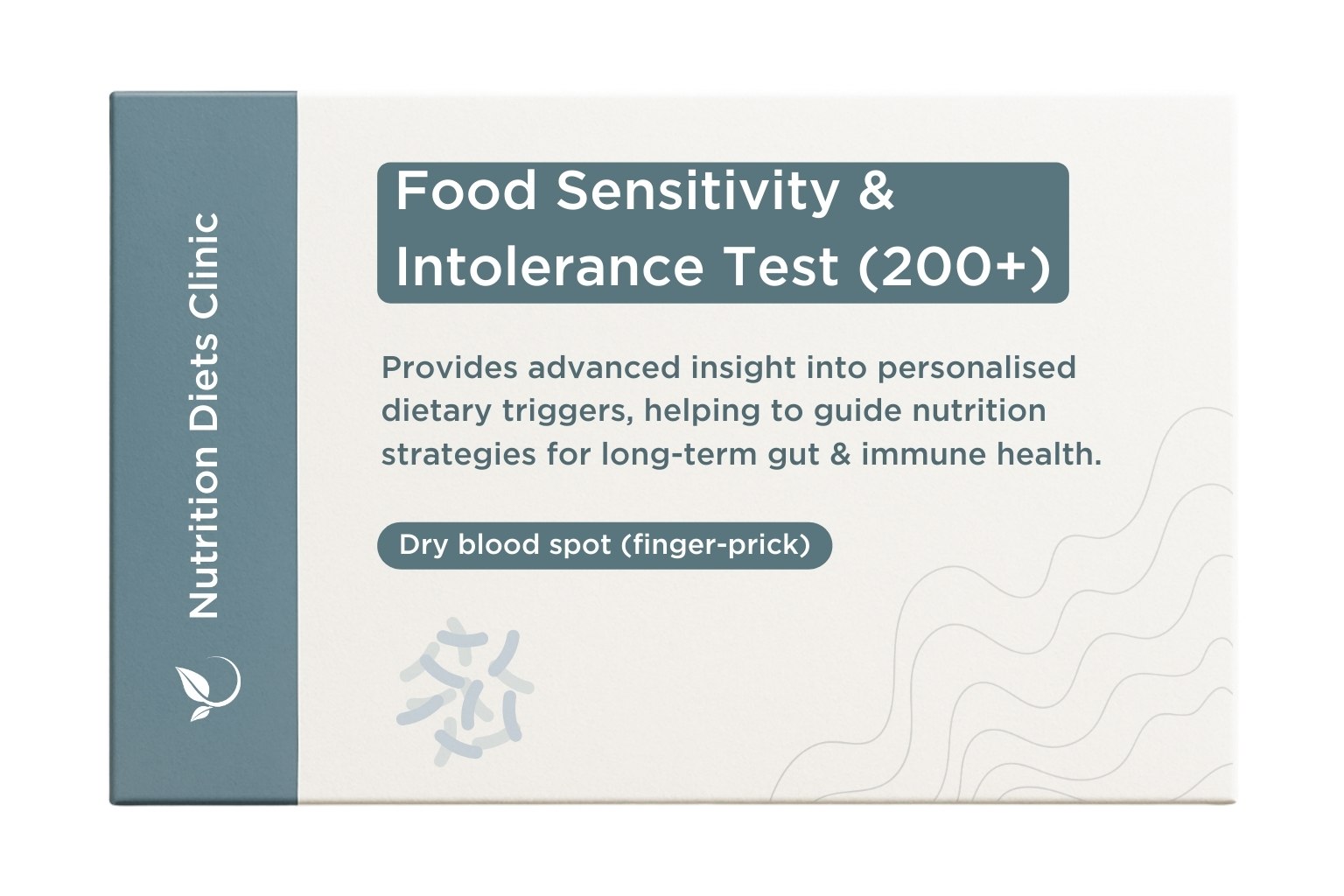
At Nutrition Diets Clinic, the at-home Food Sensitivity & Intolerance Test (200+) measures IgG reactions to more than 200 foods and ingredients from a finger-prick blood sample you take at home, with results in around seven working days. It is designed to provide a structured starting point for identifying potential triggers, not a diagnosis. Vegetarian (160+) and vegan (150+) panels are also available.

If you would like help reading your results, a 45-minute Lab Findings Review (£99) walks you through what they mean and how they may relate to your symptoms.
If you feel confident this is the right step for you, you can order the test directly. If you would prefer guidance on whether testing is appropriate for your situation, you are very welcome to book a free Discovery Call first. Before you decide, it is worth reading what an IgG test can and cannot tell you.
Step 4: Work With a Practitioner on Personalised Nutritional Therapy
The most reliable way to identify food sensitivities, and to resolve them, is personalised nutritional therapy with a practitioner experienced in how food reactions interact with the gut, the immune system and the rest of your health. The first three steps gather evidence. This is the step where it is read properly and acted on.
Food sensitivities rarely sit on their own. They are bound up with how the gut and the immune system are working, and their effects can reach well beyond digestion, into energy, mood, concentration and skin. That is why two people with the same test result can need quite different plans, and why a list of foods to avoid is seldom the whole answer.
Working with a practitioner means:
- Deciding which of the first three steps you actually need, and in what order, before you spend money or cut foods out
- Reading your diary or test result against your symptoms, history and what you really eat
- Running a structured elimination and reintroduction that keeps your diet nutritionally complete
- Looking at what may sit underneath the reactions, such as gut barrier function or an imbalanced microbiome, not only at the foods
- Bringing foods back into your diet wherever possible, rather than leaving them out indefinitely

At Nutrition Diets Clinic this starts with a 60-minute Comprehensive Consultation (£180), held online so you can do it from home, which ends with a personalised nutrition and lifestyle plan. Our food allergies and intolerances page explains how we work with food reactions. If you are not sure where you fit, a free 15-minute Discovery Call is the place to start.
What Can an IgG Food Sensitivity Test Tell You, and What Can It Not?
An IgG food sensitivity test can tell you which foods your immune system has produced IgG antibodies against. It cannot tell you, on its own, that those foods are causing your symptoms. That distinction is the whole argument about these tests, and you should hear it from us rather than find it elsewhere.
IgG testing is contested. The British Dietetic Association notes that IgG antibodies to food are found in healthy people without food allergies, so a raised IgG result does not, by itself, show intolerance. The NHS says that some tests you can buy that claim to diagnose food intolerances are not recommended, because there is limited evidence that they give accurate results and they may suggest avoiding multiple foods, which can be harmful. We think that criticism is fair when a test is sold as a diagnosis, which is how it is too often sold.
That is not how it is used at Nutrition Diets Clinic. An IgG result is a shortlist, not a verdict. It indicates which foods are worth investigating first in someone who has been eating in the dark for months, and the structured elimination and reintroduction that follows is what establishes whether a food genuinely matters for you. Acting on a printout alone is how people end up on a needlessly narrow diet with the original symptoms intact.

How Should Food Sensitivity Test Results Be Interpreted?
Food sensitivity test results should never be read in isolation.
Results are most useful when interpreted alongside:
- Symptoms
- Medical history
- Dietary patterns
Where digestive symptoms are persistent, it is also worth asking whether the gut itself is the driver rather than any particular food. An imbalance in the gut microbiome or increased intestinal permeability can make the gut react to many foods at once, and in that situation a comprehensive stool test may tell you more than a food panel.
At Nutrition Diets Clinic, testing is always interpreted within the wider context of your health, so that recommendations are appropriate, proportionate and sustainable.
Not sure whether testing is the right next step for you? Book a free Discovery Call and find out before you spend anything.
Which Approach Is Right for You?
For mild or recent symptoms, start with the diary. For a single strong suspicion, a short elimination with support. For a wide field and no idea where to begin, a test narrows it. For ongoing or complex symptoms, personalised nutritional therapy with an experienced practitioner is the most reliable route.
| Approach | Best for | Main limitation | Cost |
|---|---|---|---|
| Food and symptom diaryBest First Step | Mild or recent symptoms; building awareness | Recall bias; delayed reactions are hard to attribute | Free |
| Elimination diet | Testing a specific suspicion you already hold | Restrictive; hard to sustain; risks unnecessary narrowing | Free, but demanding |
| At-home food sensitivity test (200+ foods)Most Structured | Narrowing a wide field when you have no idea where to start | Not diagnostic; needs interpretation and a reintroduction phase | £280 |
| Personalised nutritional therapyMost Thorough | Ongoing or complex symptoms, or previous attempts that went nowhere | Requires a consultation | £180 consultation; Discovery Call free |
| All tests are clinical-grade and analysed by specialist laboratories. | |||
For people with ongoing or complex symptoms, combining testing with professional guidance is generally the most reliable route, because it is the interpretation and the structured reintroduction that produce the answer, not the result on its own. Our full guide to functional testing sets out how the wider panel of tests fits together.
Test. Don’t Guess.
Get the answers you are looking for with our range of clinical-grade at-home tests.
Easy to order. Easy to use.


What Should You Do After Identifying Food Sensitivities?
Once potential trigger foods have been identified, the next steps typically are:
- Removing trigger foods for a defined period, not indefinitely
- Supporting gut health and digestion
- Gradually reintroducing foods, one at a time, to assess tolerance
Emerging research suggests gut health plays a central role in food reactions, particularly through the gut microbiome and intestinal permeability. In one study of 108 people with IBS who had tested negative for conventional food allergies, 70% showed a breakdown of the gut barrier when individual foods were applied to the gut lining, with wheat the most common trigger. This is why addressing the gut environment often matters more, in the long run, than the list of foods itself. Where digestive symptoms are persistent, an underlying driver such as H. pylori is worth ruling out before assuming food is the whole story.
How Do You Know If You Need a Food Sensitivity Test?
Testing may be worth considering if:
- You have ongoing symptoms without a clear cause
- Your symptoms seem inconsistent or difficult to track
- You have tried dietary changes without clear results
- You want a more structured and personalised starting point
It is probably not the right first step if your symptoms are recent, mild, or already clearly linked to a single food. In that case, start with the diary and see what a fortnight of honest recording turns up.
Frequently Asked Questions About Food Sensitivity Testing
How can I test for food sensitivities at home?
In four steps: a food and symptom diary, an elimination diet, an at-home food sensitivity test, and personalised nutritional therapy with a practitioner experienced in food sensitivities. Each answers a different question. Testing can give a more structured starting point for identifying potential triggers, and a practitioner interprets the results alongside your symptoms and history rather than in isolation.
How long does it take to identify food sensitivities?
Without testing it can take several weeks or months, because reactions are delayed and patterns are hard to see. Testing can shorten the process by narrowing the field, but a structured reintroduction phase is still needed to confirm which foods genuinely matter for you.
Are food sensitivity tests accurate?
Not as a diagnosis. IgG food sensitivity tests are contested: the British Dietetic Association notes that IgG antibodies to food are found in healthy people, and the NHS does not recommend home tests that claim to diagnose intolerances. A result is a shortlist of foods to investigate, which then needs interpretation and a structured elimination and reintroduction.
Should I remove foods without testing?
Short-term elimination can be helpful, particularly where you already suspect a specific food. Long-term restriction without clarity is a different matter, and can lead to an unnecessarily narrow diet and nutritional gaps. The NHS advises against cutting foods out without advice from a GP or a food and nutrition specialist.
What is the difference between a food allergy, a food intolerance and a food sensitivity?
A food allergy is an immediate immune reaction, usually IgE-mediated, and can be serious. An intolerance is typically a digestive issue, such as lactose intolerance. Food sensitivity is the broader, less well-defined term used for delayed reactions that are harder to identify.
Can food sensitivities cause fatigue and brain fog?
They can contribute. Fatigue and brain fog are among the most commonly reported non-digestive symptoms, and because the reaction is delayed by up to 72 hours, people rarely connect them to a meal. Other causes should always be ruled out alongside.
Do food sensitivities go away?
Sometimes. Where a sensitivity is linked to gut barrier function or to an imbalance in the gut microbiome, addressing the underlying issue can improve tolerance over time, and previously reactive foods may be reintroduced successfully. This is why indefinite restriction is rarely the goal.
How much does a food sensitivity test cost in the UK?
At Nutrition Diets Clinic, the at-home Food Sensitivity & Intolerance Test (200+) costs £280. The price includes the kit, laboratory analysis and your full lab report, with free UK delivery and a prepaid return. Vegetarian (160+) and vegan (150+) panels cost £250, and results take around seven working days.
YOUR HEALTH. YOUR CHOICE.
Identifying a trigger food is rarely about the food alone. It is about understanding why the reaction is happening, how your gut and immune system are involved, and addressing what sits underneath it in the right order. If you have tried a few approaches without a clear answer, you do not have to keep guessing on your own.
This article is provided for educational purposes only and is not intended to diagnose or treat medical conditions. If you have concerning or red-flag symptoms please consult first with your GP.