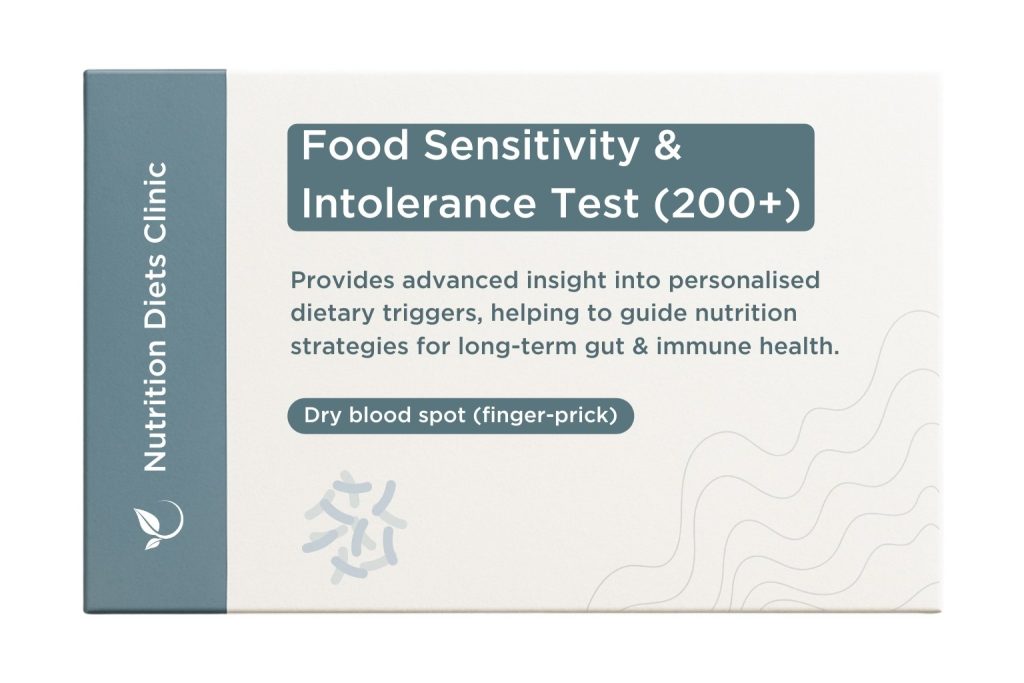


Food sensitivity test · At-home finger-prick blood · UK clinic
Food Sensitivity & Intolerance Test (200+)
The Food Sensitivity & Intolerance Test is an at-home finger-prick blood test from a UK clinic that measures your IgG immune response to more than 200 foods and ingredients, the delayed reactions that a standard allergy test does not look for. For bloating, skin flare-ups, headaches or tiredness that seem to follow meals but never point to one food.
- Free UK delivery by Royal Mail, prepaid return
- Results in 7 working days
Not sure if this is the right test for you? Book a free 15-minute Discovery Call with a registered practitioner.
What you receive
Your at-home finger-prick kit, laboratory analysis of your dried blood sample for IgG antibodies to more than 200 foods and ingredients, plus a lab report that grades your reaction to each food so you and your practitioner can see which ones to test removing and which to leave alone. See the full list of foods tested (PDF) and a sample report (PDF).
Delivery and turnaround
Free UK delivery by Royal Mail 48-hour service and prepaid return, both included in the price. Kits are dispatched within 1 to 2 working days. Results ready approximately 7 working days from when the lab receives your sample. International delivery is available, with costs calculated at checkout.
What does the Food Sensitivity Test measure?
It measures your IgG antibody response to more than 200 foods and ingredients across every major food group, and grades each one, so the report shows the pattern of what your immune system is reacting to rather than a single yes or no.
Dairy, eggs & gluten grains
The foods most often behind delayed reactions, each graded separately rather than lumped together as a group.
Fruit, vegetables, herbs & spices
The long tail of everyday ingredients, where a reaction to one thing can hide inside a dish.
Grains, legumes, nuts & seeds
The staples that are hardest to spot by elimination alone, because they are eaten most days.
Meat, fish & seafood
The common animal proteins, including the fish and seafood that often surprise people.
See every food tested, in nine groupsTap or click a group to see every food in it
Dairy & eggs
Cow’s, goat’s, sheep’s and buffalo milk, the main milk proteins tested on their own, and egg white and yolk separately.
- Alpha-Lactalbumin
- Beta-Lactoglobulin
- Casein
- Egg White
- Egg Yolk
- Milk (Buffalo)
- Milk (Cow)
- Milk (Goat)
- Milk (Sheep)
Fish & seafood
Oily and white fish, shellfish and molluscs.
- Anchovy
- Bass
- Carp
- Caviar
- Clam
- Cockle
- Cod
- Crab
- Cuttlefish
- Eel
- Haddock
- Hake
- Herring
- Lobster
- Mackerel
- Monkfish
- Mussel
- Octopus
- Oyster
- Perch
- Pike
- Plaice
- Salmon
- Sardine
- Scallop
- Sea Bream (Gilthead)
- Shrimp/Prawn
- Sole
- Squid
- Swordfish
- Trout
- Tuna
- Turbot
Fruit
Everyday and tropical fruit, berries and dried fruit.
- Apple
- Apricot
- Avocado
- Banana
- Blackberry
- Blackcurrant
- Blueberry
- Cherry
- Cranberry
- Date
- Fig
- Grape (Black/Red/White)
- Grapefruit
- Guava
- Kiwi
- Lemon
- Lime
- Lychee
- Mango
- Melon (Galia/Honeydew)
- Mulberry
- Nectarine
- Olive
- Orange
- Papaya
- Peach
- Pear
- Pineapple
- Plum
- Pomegranate
- Raisin
- Raspberry
- Redcurrant
- Rhubarb
- Strawberry
- Tangerine
- Watermelon
Grains
Gluten grains, gluten-free grains and seeds eaten as grains, with gliadin, the main gluten protein, tested on its own.
- Amaranth
- Barley
- Buckwheat
- Corn (Maize)
- Couscous
- Durum Wheat
- Gliadin
- Malt
- Millet
- Oat
- Quinoa
- Rice
- Rye
- Spelt
- Tapioca
- Wheat
- Wheat Bran
Herbs, spices & herbal teas
Culinary herbs and spices, plus herbs taken as teas. Curry is tested as a mix of 14 spices: coriander, turmeric, cinnamon, paprika, garlic, onion, cumin, ginger, mustard, pepper, cardamom, chilli, cloves and nutmeg.
- Aniseed
- Basil
- Bayleaf
- Camomile
- Cayenne
- Chilli (Red)
- Cinnamon
- Clove
- Coriander (Leaf)
- Cumin
- Curry (mixed spices)
- Dill
- Garlic
- Ginger
- Ginseng
- Hops
- Liquorice
- Marjoram
- Mint
- Mustard Seed
- Nettle
- Nutmeg
- Parsley
- Peppercorn (Black/White)
- Peppermint
- Rosemary
- Saffron
- Sage
- Tarragon
- Thyme
- Vanilla
Meat, poultry & game
Red meat, poultry and game.
- Beef
- Chicken
- Duck
- Horse
- Lamb
- Ostrich
- Partridge
- Pork
- Quail
- Rabbit
- Turkey
- Veal
- Venison
- Wild Boar
Other foods
Coffee, tea, cocoa, yeasts, mushroom and other ingredients that sit outside the main groups.
- Agar Agar
- Aloe Vera
- Carob
- Chestnut
- Cocoa Bean
- Coffee
- Mushroom
- Tea (Black)
- Tea (Green)
- Yeast (baker’s)
- Yeast (brewer’s)
Nuts & seeds
Tree nuts, peanut, coconut and seeds, including rapeseed.
- Almond
- Brazil Nut
- Cashew Nut
- Coconut
- Flax Seed
- Hazelnut
- Macadamia Nut
- Peanut
- Pine Nut
- Pistachio
- Rapeseed
- Sesame Seed
- Sunflower Seed
- Tiger Nut
- Walnut
Vegetables & pulses
Vegetables, with beans, lentils, chickpea and soya bean.
- Artichoke
- Asparagus
- Aubergine
- Bean (Broad)
- Bean (Green)
- Bean (Red Kidney)
- Bean (White Haricot)
- Beetroot
- Broccoli
- Brussels Sprout
- Cabbage (Red)
- Cabbage (Savoy/White)
- Caper
- Carrot
- Cauliflower
- Celery
- Chard
- Chickpea
- Chicory
- Cucumber
- Fennel (Leaf)
- Leek
- Lentil
- Lettuce
- Marrow
- Onion
- Pea
- Pepper (Green/Red/Yellow)
- Potato
- Radish
- Rocket
- Shallot
- Soya Bean
- Spinach
- Squash (Butternut/Carnival)
- Sweet Potato
- Tomato
- Turnip
- Watercress
- Yuca
Who is the Food Sensitivity Test for?
For symptoms that seem to follow eating but never point to one food, when an allergy test has come back clear or you have tried cutting things out without an answer.
Acne, eczema, rashes
Often linked to: food-driven inflammation, often with a gut component.
This test measures: IgG reactions to dairy, eggs, gluten grains and the rest of the panel.
Bloating after meals
Often linked to: a delayed immune reaction to one or more everyday foods.
This test measures: IgG antibodies to more than 200 foods, graded by strength.
Brain fog
Often linked to: delayed food reactions, often to gluten grains or dairy.
This test measures: the gluten grains, the dairy group and the rest of the panel.
Headaches & migraines
Often linked to: reactions to specific foods or food groups.
This test measures: reactions across every food group, including the common migraine triggers.
IBS that diet changes have not fixed
Often linked to: reactions to foods that were never on the suspect list.
This test measures: more than 200 foods, so the unlikely ones are tested too.
Joint aches
Often linked to: food-driven inflammation.
This test measures: the strength of your IgG reaction to each food and group.
Low mood & irritability
Often linked to: food reactions acting through the gut-brain axis.
This test measures: the foods you react to most strongly, graded.
Nasal congestion & sinus trouble
Often linked to: reactions to dairy or other foods.
This test measures: the dairy group alongside every other food group.
Reflux & indigestion
Often linked to: reactions to specific foods or drinks.
This test measures: IgG reactions across the panel, including grains, dairy and spices.
Stomach aches & cramps
Often linked to: reactions to foods eaten most days, which is why they are hard to spot.
This test measures: the full food panel, so a reaction to a staple shows up.
Tiredness after eating
Often linked to: an immune response to a food you eat regularly.
This test measures: IgG reactions to the staples you eat most days.
Unexplained weight changes
Often linked to: inflammation driven by foods you eat often.
This test measures: your reaction grade to each of the staples in your diet.
How does the at-home food sensitivity test work?
A few drops of blood from a finger prick onto the collection card, dried at home, then posted back with the prepaid return.
Order online
Secure checkout. No clinic visit or GP referral required.
Your kit arrives by post
Dispatched within 1 to 2 working days. Delivered by Royal Mail 48-hour service.
Finger-prick at home
A few drops of blood on the collection card, following the instructions in the kit. Let it dry before packing.
Return with the prepaid label
Post it back with the prepaid return in the kit. Results ready in 7 working days.

How do I interpret my results?
Making sense of a lab report is the most important part of testing. Once your results are ready, your lab report is uploaded to your secure Client Folder. From there, you choose your level of support from our UK-registered nutritional therapist (optional, priced separately): a Lab Findings Review or a Comprehensive Consultation.
BSc, mBANT, CNHC, NLP Dip


Which consultation is right for me?
Understand your results with a Lab Findings Review, or go a step further and act on them with a Comprehensive Consultation.

Lab Findings Review
£99- Clinical analysis of your lab results
- What the findings mean for your symptoms and health
- Time for your questions
Comprehensive Consultation
£180- Everything in the Lab Findings Review
- In-depth review of your health history, diet and lifestyle (Health Questionnaire and Food & Symptoms Diary)
- A fully personalised nutrition & lifestyle action plan
What do our customers say?
“This Food intolerance test helped me identify multiple foods that I have low grade intolerance to (eggs and onions) that I did not suspect at all and that have been causing my symptoms without me realising.”
PujaVerified customerA useful addition after the GI-MAP
This was a useful addition to my other results. Carmen explained the in depth information and gave me practical steps to restore my system back to health- with her expert advice, it avoided me eliminating foods unnecessarily. The kit arrived quickly, was very easy to use and collection was fast.
ZaraVerified customerFindings later confirmed by a gastroenterologist
I was unable to digest anything when I first met Carmen but using this GI MAP test she identified what was wrong (her findings were confirmed later by intensive testing by a gastroenterologist). I can't recommend working with her more.
AishaVerified customerReview of the Comprehensive Stool Test (GI MAP) Plus ZonulinRead all 2 reviews of this testWrite a review
Add a review
Frequently Asked Questions
Can I do the Food Sensitivity Test at home in the UK?
Yes. It is an at-home test: you order online, the kit comes to your door by Royal Mail, you collect at home and the prepaid return takes it to the lab. No GP referral or clinic visit is needed. We send kits to any UK address, and international delivery is priced at checkout.
What is the difference between a food sensitivity test and a food allergy test?
An allergy test looks for IgE antibodies, the immediate reactions that cause hives, swelling or anaphylaxis within minutes. This test looks for IgG antibodies, the delayed reactions that show up hours or days later as bloating, skin, headaches or tiredness, which is why they are so hard to trace by hand. If you follow a plant-based diet, the vegan and vegetarian versions of this panel test the foods you actually eat.
Is a food sensitivity test worth it if I have already tried an elimination diet?
Often, yes. An elimination diet can only test the foods you suspect, one at a time, and reactions to a food eaten every day are the ones people miss. The panel tests more than 200 foods at once and grades each, so it can confirm the foods you suspected and show the ones you did not. It is also the quickest way to avoid cutting out foods you do not need to.
How accurate is the Food Sensitivity Test?
The test measures IgG antibodies to each food in a dried blood sample using a laboratory immunoassay, and reports a graded result rather than a simple positive or negative. IgG testing shows what your immune system has been exposed to and reacting to; it is a guide to which foods to trial removing, not a diagnosis of allergy, which is why a practitioner reads it against your diet and symptoms before anything is cut out. Like any lab test, the report is a snapshot of recent months.
Can I get the Food Sensitivity Test on the NHS?
No. The NHS tests for food allergy (IgE) when there is a history of immediate reactions, but it does not offer IgG food sensitivity panels. This is a private test ordered through a clinic. The price covers the kit, the lab analysis and your graded report; having the report interpreted is a separate, optional consultation.
When should I collect my sample?
Any morning, and ideally after a few weeks of eating your normal diet, because the test measures the foods your immune system has recently met; a food you have avoided for months may not register. Warm hands, prick the side of a fingertip with the lancet in the kit, fill the spots on the collection card, let it dry fully, then post it back with the prepaid return the same day or the next. Full instructions are in the kit.
Can someone help me interpret my results, even if I tested elsewhere?
Yes. Book a Lab Findings Review with us and a registered nutritional therapist will take you through every marker against your symptoms and history, whether you tested with us or elsewhere; bring your report to the session. If you then want a personalised plan, that is the Comprehensive Consultation.



2 reviews for Food Sensitivity & Intolerance Test (200+)
Zara verified customer
After completing the GI-map plus Zonulin test, I decided to follow it with the food sensitivity test to further investigate any foods that may be contributing to digestive discomfort and inflammation. This was a useful addition to my other results. Carmen explained the in depth information and gave me practical steps to restore my system back to health- with her expert advice, it avoided me eliminating foods unnecessarily. The kit arrived quickly, was very easy to use and collection was fast. I’m very happy with the test and follow up support that I received, would definitely recommend!
Puja verified customer
I was getting quite intense bloating, stomach aches and feeling quite exhausted after eating certain meals. This Food intolerance test helped me identify multiple foods that I have low grade intolerance to (eggs and onions) that I did not suspect at all and that have been causing my symptoms without me realising. The test is very advanced, covering a a lot of different food groups and it’s very revealing to see which foods you’ve been eating that your body doesn’t process well.